Picture this: you are 35,000 feet in the air, the Wi-Fi is off, and the AI model on your laptop just built you a playable flight simulator. No cloud. No API key. No data leaving your machine.
That is not a fantasy. It is exactly what researchers did with Inkling 2 Mini, and it is why the whole AI world is talking about it. If you are asking what is Inkling 2 Mini, here is the short version: it is a 26.4-billion-parameter model that fits in about 20GB of memory, reasons like a model many times its size, and runs on hardware you may already own.
Released on November 20, 2026, by Thinking Machines Lab, Inkling 2 Mini arrived quietly and landed loudly. Within 48 hours, benchmark trackers and developers were calling it one of the most important open model releases of the year. In this guide, we answer the question “what is Inkling 2 Mini” in full: how it works, what the benchmarks show, what it costs, and how you can run it yourself. By the end, you will know exactly what is Inkling 2 Mini and how to use it.
What Is Inkling 2 Mini? The Short Answer

So, what is Inkling 2 Mini, exactly? It is an open-weights AI model released on November 20, 2026, by Thinking Machines Lab, the AI research company founded by former OpenAI CTO Mira Murati. It is built for agentic coding, tool use, long-context research, knowledge work, and visual reasoning — and it is small enough to run on a laptop.
The weights are published under the Apache 2.0 license, so anyone can download, use, modify, and even commercialize the model with very few restrictions. When people ask what is Inkling 2 Mini and why it is different, the answer starts here: you can own it, run it offline, and fine-tune it for your own work. Most of the strongest AI models are locked behind APIs. This one is yours.
Here is why people care: Inkling 2 Mini leads every open-weights model under 100 billion parameters on two of the toughest benchmarks in AI — DeepSWE and the Vals Index — while fitting in roughly 20GB of memory. The bottom line: what is Inkling 2 Mini, in one sentence? It is frontier-level reasoning in a laptop-sized package, free to download and free to use.
The Looped Transformer: How Inkling 2 Mini Thinks Longer
Most AI models think the way a student reads a textbook: one pass, front to back, and then they answer. Inkling 2 Mini does something smarter. It re-reads the middle of the book.
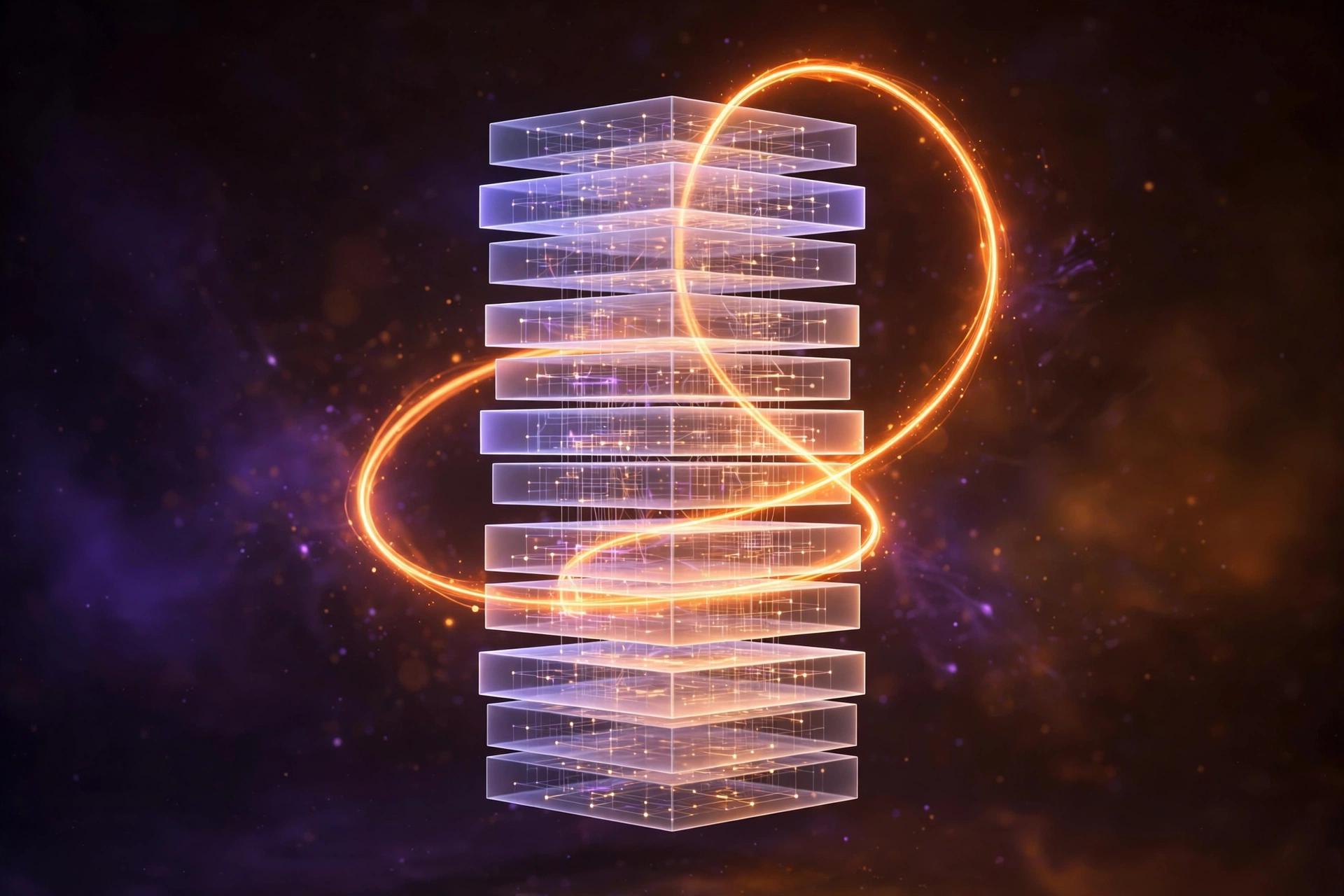
To understand what is Inkling 2 Mini at the architectural level, look at its layers. A standard transformer is built from stacked layers, each processing the input once. Inkling 2 Mini has 24 layers, but the middle 12 run three times for every token it generates — 48 layer applications from just 24 stored layers. The model loops its thinking through the same middle layers again and again, refining its understanding each time.
Why does that matter? Looping lets the model reason longer without writing its reasoning down. Normally, a model that wants to think harder must generate long chains of reasoning text — thousands of “thinking tokens” that cost time and money. Inkling 2 Mini does much of that thinking inside its own layers, silently, before it ever writes a word.
The key takeaway: Inkling 2 Mini trades memory for thinking time. Instead of storing more layers, it reuses the layers it has. That is the architectural answer to what is Inkling 2 Mini. That looping trick is the core of what is Inkling 2 Mini, and it is why a small model can compete with far larger ones. It also explains why the model is so good at agentic coding and multi-step tasks: it chews on a problem internally before committing to an answer.
Inkling 2 Mini Specs at a Glance
The specs below answer what is Inkling 2 Mini in numbers. Here are the headline figures — the numbers behind what is Inkling 2 Mini:
- Total parameters: 26.4 billion
- Active parameters per token: 3.4 billion
- Weight activations per token: 5.4 billion
- Architecture: Looped transformer — 24 layers, middle 12 run 3 times per token (48 layer applications)
- Memory footprint: About 20GB
- Context window: 1 million tokens
- Input: Text and images
- Output: Text
- License: Open weights, Apache 2.0
- Release date: November 20, 2026
- Developer: Thinking Machines Lab (Mira Murati’s lab)
The number that matters most is the 20GB footprint — small enough for a 32GB+ RAM Mac, a single NVIDIA DGX Spark, or a GPU with 32GB or more of VRAM. You do not need a data center.
The 1-million-token context window is the other headline figure: roughly 750,000 words, enough to load an entire codebase or a stack of research papers into one conversation. And only 3.4 billion parameters are active per token, which keeps the model fast. The bottom line: what is Inkling 2 Mini, as a package? A small model that thinks hard, remembers a lot, and runs anywhere.
Inkling 2 Mini Benchmarks: How Good Is It Really?
Anyone asking what is Inkling 2 Mini should look at the benchmarks first. For anyone still asking what is Inkling 2 Mini, the coding scores are the clearest proof. The scores below show what is Inkling 2 Mini capable of, based on vendor-reported results from Thinking Machines Lab.
On DeepSWE v1.1, a test of real-world software engineering, Inkling 2 Mini scores 48.2%. On SWE-bench Verified, the standard test of fixing real bugs in real open-source code, it scores 79.2%. On SWE-bench Pro v2 Hard, a tougher version of the same test, it scores 77.9%. On the Vals Index v2.2, which measures broad capability across many tasks, it scores 46.5%. And on the Artificial Analysis Intelligence Index, it scores 20.
In plain English: Inkling 2 Mini leads every open-weights model under 100 billion parameters on both DeepSWE and the Vals Index. No other open model in its size class beats it on those two tests. That is the headline result.
The coding scores deserve special attention. A 79.2% on SWE-bench Verified puts Inkling 2 Mini in the same conversation as models that cost far more to run. It can take a real bug report, find the problem in a real codebase, and write a fix that passes the project’s own tests — most of the time.
Artificial Analysis, a respected independent benchmark tracker, has published its own analysis. Their Intelligence Index score of 20 confirms the model sits well above other open models in its class. Read their full breakdown on Artificial Analysis.
One honest caveat: these are vendor-reported numbers, and independent testing is still catching up. Benchmarks never tell the whole story either — real quality shows up in daily use. But the early independent signals point in the same direction as the official numbers. The key takeaway: on the benchmarks that matter for coding and knowledge work, Inkling 2 Mini is the best open model under 100 billion parameters available today.
Inkling 2 Mini vs Tencent Hy4 vs Claude Opus 5.5
If you are still wondering what is Inkling 2 Mini compared with its rivals, this table gives the answer. It compares Inkling 2 Mini with Tencent Hy4, another open-weights model, and Claude Opus 5.5, Anthropic’s closed flagship.
| Feature | Inkling 2 Mini | Tencent Hy4 | Claude Opus 5.5 |
|---|---|---|---|
| Developer | Thinking Machines Lab | Tencent | Anthropic |
| Released | Nov 20, 2026 | Nov 4, 2026 (GA) | Sep 22, 2026 |
| License | Open weights, Apache 2.0 | Open weights (preview Apache 2.0; full release under Tencent Hy License) | Closed (API only) |
| Total parameters | 26.4B | 770B | Not disclosed |
| Active parameters per token | 3.4B | 49B | Not disclosed |
| Context window | 1M tokens | 1M tokens | 1M tokens |
| Runs on a laptop? | Yes (~20GB) | No (needs a GPU cluster) | No (cloud only) |
| API input price | $0.075 / 1M tokens | $0.417 / 1M tokens (OpenRouter) | $4 / 1M tokens |
| API output price | $0.30 / 1M tokens | $1.25 / 1M tokens (OpenRouter) | $20 / 1M tokens |
| Best for | Local deployment, agentic coding, long-context research | Heavy agentic coding at scale | Maximum capability, everyday professional work |
The table shows what is Inkling 2 Mini up against — and where it wins. The contrast is striking. Tencent Hy4 is far bigger — 770 billion total parameters against Inkling 2 Mini’s 26.4 billion — and one of the strongest open models for agentic coding at scale. But you cannot run Hy4 on a laptop; it needs serious GPU infrastructure. See our guide to Tencent Hy4 for more.
Claude Opus 5.5 is the opposite end of the spectrum: a closed flagship available only through Anthropic’s API or cloud partners. It is more capable than Inkling 2 Mini on the hardest tasks, but it costs roughly 53 times more per input token and 67 times more per output token. Read our guide to Claude Opus 5.5 for the full picture.
The key takeaway: Inkling 2 Mini is not the most powerful model in the world. It is the most powerful model you can run on your own machine — and the cheapest to call through an API. The comparison answers what is Inkling 2 Mini in context: the best local and open choice, not the best model, period.
How to Run Inkling 2 Mini on Your Laptop
Once you know what is Inkling 2 Mini, the next question is how to run it. The good news: it is easy. Because the weights are open and the footprint is about 20GB, you have several good options.
Ollama is the easiest route for most people. Inkling 2 Mini is available on Ollama, the popular tool for running models locally. If you already use Ollama, pulling the model and chatting with it takes a few minutes. No cloud account, no API key, no setup beyond the download.
Hugging Face is the home of the official weights. Download the weights directly and run them with your framework of choice — vLLM, SGLang, llama.cpp, or anything else that supports the format. This is the route for developers who want full control.
Tinker handles inference and fine-tuning. Thinking Machines Lab’s own Tinker platform supports Inkling 2 Mini for both running the model and fine-tuning it on your own data. If you want to teach the model your company’s codebase, Tinker is the official path.
GGUF builds via Unsloth make it even lighter. Unsloth provides GGUF builds designed for efficient local inference on consumer hardware — the format tools like llama.cpp use, and a favorite of the local-AI community.
Whichever route you pick, trying what is Inkling 2 Mini takes minutes, not hours. Before you start, check your hardware: a Mac with 32GB or more of RAM, a single NVIDIA DGX Spark, or a GPU with 32GB or more of VRAM. That is a fraction of what most frontier models demand. The key takeaway: you do not need a server room to run Inkling 2 Mini. A good laptop is enough, and Ollama is the fastest way to start.
A Real-World Example: The Flight Simulator on a Plane
Here is the story that made Inkling 2 Mini famous — and it is a true one. It is also the best answer to what is Inkling 2 Mini in practice.
Researchers ran Inkling 2 Mini offline on a MacBook Pro during a flight. No internet connection. No cloud. Just the model, the laptop, and a prompt. In a few minutes, the model built a playable flight simulator — working code, running locally, on a plane.
Think about what that means. A few years ago, building a small game like that would have taken a developer hours. A year ago, it would have needed a cloud API and a fast connection. Now a laptop-sized model does it offline, in minutes, at 35,000 feet.
This is more than a fun demo. The demo answers what is Inkling 2 Mini better than any spec sheet. A developer on a plane, a researcher in the field, a doctor in a rural clinic, a journalist protecting a source — all of them can now use a genuinely capable AI model with no connection at all. The data never leaves the device. A model that needs a data center can only ever be a service. A model that fits on a laptop can be a tool — yours, offline, private, and always available. That is the real promise of Inkling 2 Mini: frontier-class help, anywhere, even on a plane.
Inkling 2 Mini Pricing: What It Costs via API
So what is Inkling 2 Mini going to cost you via API? Strikingly little. Through OpenRouter, Inkling 2 Mini costs $0.075 per million input tokens and $0.30 per million output tokens. A million tokens is roughly 750,000 words — about ten full-length novels. Processing ten novels’ worth of input costs less than eight cents.
Compare that with Claude Opus 5.5 at $4 per million input tokens and $20 per million output tokens. Inkling 2 Mini is about 53 times cheaper on input and about 67 times cheaper on output. Even against Tencent Hy4’s OpenRouter pricing of $0.417 input and $1.25 output, Inkling 2 Mini is roughly 5 to 6 times cheaper.
At these rates, what is Inkling 2 Mini costs less per day than a cup of coffee for most teams. For a small business or an independent developer, that difference is decisive. You can build an AI feature, run thousands of requests a day, and still spend less on AI than on coffee. And if you run the model locally, the marginal cost drops to zero — you pay for the hardware once, and every token after that is free.
The key takeaway: whether you use the API or run it locally, Inkling 2 Mini is one of the cheapest ways to get serious AI capability in 2026. The pricing answers a big part of what is Inkling 2 Mini: the cheapest serious AI you can own. One note: API prices change, so always check the current rate on your provider before building a budget around it.
What Is Inkling 2 Mini Best For?

To see what is Inkling 2 Mini best at, look at what it was designed for. Each of these jobs shows a different side of what is Inkling 2 Mini. Thinking Machines Lab built it for a specific set of jobs.
Agentic coding. This is the headline use case. With 79.2% on SWE-bench Verified and 77.9% on SWE-bench Pro v2 Hard, Inkling 2 Mini can work on real codebases, fix real bugs, and build real features. It works with tools — running commands, reading files, editing code, and checking its own work in a loop.
Tool use. Beyond coding, Inkling 2 Mini calls tools reliably: searching the web, querying databases, and chaining actions together. That makes it a strong choice for AI agents that do multi-step work, not just chat.
Long-context research. The 1-million-token context window means you can feed the model an entire codebase, a stack of legal documents, or a year of company reports and ask questions across all of it. For researchers, analysts, and lawyers, that is a genuine productivity leap.
Knowledge work and visual reasoning. Summarizing documents, drafting reports, answering questions from your own files — Inkling 2 Mini handles the everyday knowledge work that eats up professional time. Because you can run it locally, sensitive documents never leave your machine. It also accepts image input, so it can reason about a screenshot, a chart, or a photo.
Local deployment. This is the use case that sets Inkling 2 Mini apart from every closed model. If your data cannot leave your building — healthcare, legal, finance, government — a model you run yourself is the only option. Inkling 2 Mini is the strongest local model in its class.
For a broader look at how the newest AI models compare, see our guide to Gemini 4 Carbon, Google’s latest flagship and one of the models Inkling 2 Mini is measured against.
Inkling 2 Mini Limitations: What It Can’t Do
A fair answer to what is Inkling 2 Mini includes its limits. Knowing what is Inkling 2 Mini means knowing where it falls short, too. No model is perfect, and honest coverage means saying so.
It is not the most capable model overall. Closed flagships like Claude Opus 5.5 and Google’s Gemini 4 Carbon still lead on the hardest reasoning tasks. If your work needs the absolute best performance money can buy, Inkling 2 Mini is not the top choice.
It only outputs text. Inkling 2 Mini accepts text and image input, but its output is text only. It cannot generate images, audio, or video. If you need multimodal output, you will need a different model.
It is brand new. Released on November 20, 2026, Inkling 2 Mini has only days of real-world use behind it. The ecosystem is still forming: fewer integrations, fewer tutorials, fewer community fixes than older models enjoy. Early adopters should expect some rough edges.
The benchmarks are vendor-reported. Thinking Machines Lab published the benchmark numbers, and independent confirmation is still limited. The early independent signals are positive, but the full picture will only emerge over the coming weeks.
Local hardware still matters. “Runs on a laptop” means a good laptop — 32GB of RAM or more, or a GPU with 32GB of VRAM. A basic laptop with 8GB or 16GB of RAM will not run it comfortably. The barrier is far lower than it used to be, but it is not zero.
The key takeaway: Inkling 2 Mini is a remarkable model with real limits. It wins on local deployment, cost, and openness — not on raw capability against the biggest closed models.
Frequently Asked Questions About Inkling 2 Mini
What is Inkling 2 Mini in simple terms?
What is Inkling 2 Mini, in the simplest terms? It is a free, open AI model from Thinking Machines Lab that is smart enough for serious coding and research, yet small enough — about 20GB — to run on a laptop. You can download it, use it offline, and even build commercial products with it under the Apache 2.0 license.
Can I really run Inkling 2 Mini on a laptop?
Yes. Inkling 2 Mini needs about 20GB of memory, so it runs on a Mac with 32GB or more of RAM, a single NVIDIA DGX Spark, or a GPU with 32GB or more of VRAM. Researchers have run it offline on a MacBook Pro on a flight. The easiest way to try it is through Ollama, and GGUF builds via Unsloth make local setup even simpler.
Is Inkling 2 Mini free to use?
Yes. The model weights are open under the Apache 2.0 license, so downloading and running them is free. If you use it through an API instead, OpenRouter charges $0.075 per million input tokens and $0.30 per million output tokens — among the cheapest rates for a model of this capability. That is what is Inkling 2 Mini costs: free locally, pennies via API.
How does Inkling 2 Mini compare to closed models like Claude Opus 5.5?
Inkling 2 Mini is not as capable as Claude Opus 5.5 on the hardest tasks — closed flagships still lead on raw performance. But Inkling 2 Mini is far cheaper (about 53 times cheaper per input token via API), fully open, and runnable on your own hardware. That is the honest answer to what is Inkling 2 Mini versus a closed flagship: for most coding and knowledge work, the gap is smaller than the price difference suggests.
What is a looped transformer?
A looped transformer is a model design in which some layers run more than once for each token. Inkling 2 Mini has 24 layers, and the middle 12 run three times per token, giving 48 layer applications from 24 stored layers. Looping lets the model reason longer internally without writing out long chains of reasoning text, which is how a small model achieves big-model results.
Where can I download Inkling 2 Mini?
Inkling 2 Mini is available on Hugging Face (official weights), Ollama (easiest local setup), Tinker (inference and fine-tuning from Thinking Machines Lab), and as GGUF builds via Unsloth. If you want to try what is Inkling 2 Mini for yourself, start with Ollama. The official announcement is on the Thinking Machines Lab website, and MarkTechPost has a clear technical summary (MarkTechPost).
Conclusion: Why Inkling 2 Mini Matters
So, what is Inkling 2 Mini, and why should you care? It is proof that the future of AI is not only bigger models in bigger data centers. It is also smaller, smarter models that you can own, run offline, and afford.
When people ask what is Inkling 2 Mini and whether it is worth their time, the numbers give the answer. It leads every open-weights model under 100 billion parameters on DeepSWE and the Vals Index. It scores 79.2% on SWE-bench Verified. It holds a million tokens of context. It costs $0.075 per million input tokens through an API — or nothing at all on your own laptop. And it does all of this in about 20GB of memory.
The short version of what is Inkling 2 Mini is simple: big reasoning, small footprint, yours to run. The looped transformer is the idea that makes it possible: 24 layers, the middle 12 running three times, thinking longer without writing it all down. If you write code, do research, or handle sensitive data, Inkling 2 Mini is worth your time. Download it from Hugging Face, pull it with Ollama, or try it through an API for pennies. The model that built a flight simulator on a plane is now sitting there, free, waiting for your laptop.
The bottom line: what is Inkling 2 Mini? It is the most capable AI you can run on your own machine — and in 2026, that matters more than ever.