Last year, only 6% of US consumers used AI tools to find a local business. In 2026, that number is 45%. Nearly half of your potential customers now ask an AI assistant — usually ChatGPT — before touching Google. If you want to know how to get ChatGPT to recommend your business, act now — before your competitors do.
ChatGPT has 1.2 billion weekly users, with search queries at ~20% of Google’s volume. One honest note: claiming a profile does not guarantee recommendations. What it buys you is accuracy — ChatGPT uses your facts, not scraped guesses.
Why ChatGPT Recommendations Matter More Than Ever in 2026
BrightLocal’s 2026 survey of 1,002 US adults found 45% of consumers have used AI tools for local business recommendations, up from 6% a year earlier. AI is now the third most-used discovery channel after Google and Facebook, and ChatGPT leads it at 31%.
Yext found 28% of consumers tried a new local business in the past six months because an AI assistant recommended it. And 88% of AI users fact-check the recommendation — wrong hours, prices, or phone numbers get caught fast. Getting recommended by ChatGPT is becoming as valuable as ranking on Google.
That is the shift behind this guide: how to get ChatGPT to recommend your business, step by step, starting with the free profile OpenAI launched in November 2026.
How to Get ChatGPT to Recommend Your Business: Claim Your Business Hub Profile First
On 10 November 2026, OpenAI launched Businesses in ChatGPT — the ChatGPT Business Hub — in beta. A business can now claim its ChatGPT business profile, verify ownership, add a product feed, and see its own mention and click data — free, and the first step in how to get your business listed on ChatGPT.
- Sign in with a business-controlled ChatGPT account.
- Find your listing by name; select it or create one.
- Verify ownership by phone code, email code, DNS record, or Shopify.
- Wait for OpenAI’s emailed decision.
- Verify your identity with Persona (government-issued ID) to publish edits and view Insights.
- Complete the profile: website, description, category, logo, cover photo, policies, and a product feed if you sell online.
- Check your Insights: mentions and clicks over the past 28 days.
The Business Hub currently targets US ecommerce and online service businesses; physical storefronts may land on a waitlist — join it and do the groundwork below while you wait.
How to Get ChatGPT to Recommend Your Business: The Full Business Hub Claim Walkthrough
The seven steps above are the outline. Here is the detail that trips most businesses up — because claiming involves two separate checks, not one. The first proves you control the business. The second proves you are a real person allowed to act for it. If you are working out how to get ChatGPT to recommend your business, getting both checks right is the difference between a profile that works and one that sits locked.
Start with the right account. Sign in to ChatGPT with a business-controlled account — the account that claims the business becomes its admin, and it can later add teammates or grant an agency access. Claiming from a personal account creates a mess to untangle later, and it is one of the quietest mistakes in how to get ChatGPT to recommend your business.
Find or create your listing. Open Business Hub from the ChatGPT sidebar or go to chatgpt.com/business-hub and search for your business by name. If you run an online business and no listing appears, you may be able to add one. Local stores and restaurants can currently claim only an existing US listing — they cannot add a new one yet. If no listing appears and you cannot add one, join the waitlist and do the groundwork in the sections below — the claim is only one piece of how to get ChatGPT to recommend your business.
Prove you control the business. Business Hub offers the verification methods available for your business — you will not always see all four, so pick the one you genuinely control: a code by text or automated call to your business phone; a code to your business email; a TXT record added to your domain’s DNS settings; or a Shopify connection, which also links your product catalog. OpenAI reviews the claim and emails you the decision.
One profile per website: if someone already submitted a profile for your domain, you will see “A business profile has already been submitted for this website.” Ask a colleague to add you as a teammate instead of starting again — or use the ownership dispute process if the claim is not from your company.
Pick the method you control today: a failed verification attempt is the most common reason businesses stall on how to get ChatGPT to recommend your business. Shopify sellers get a bonus here: connecting the store also links the product catalog, which is the fastest route in how to get ChatGPT to recommend your business for an online store.
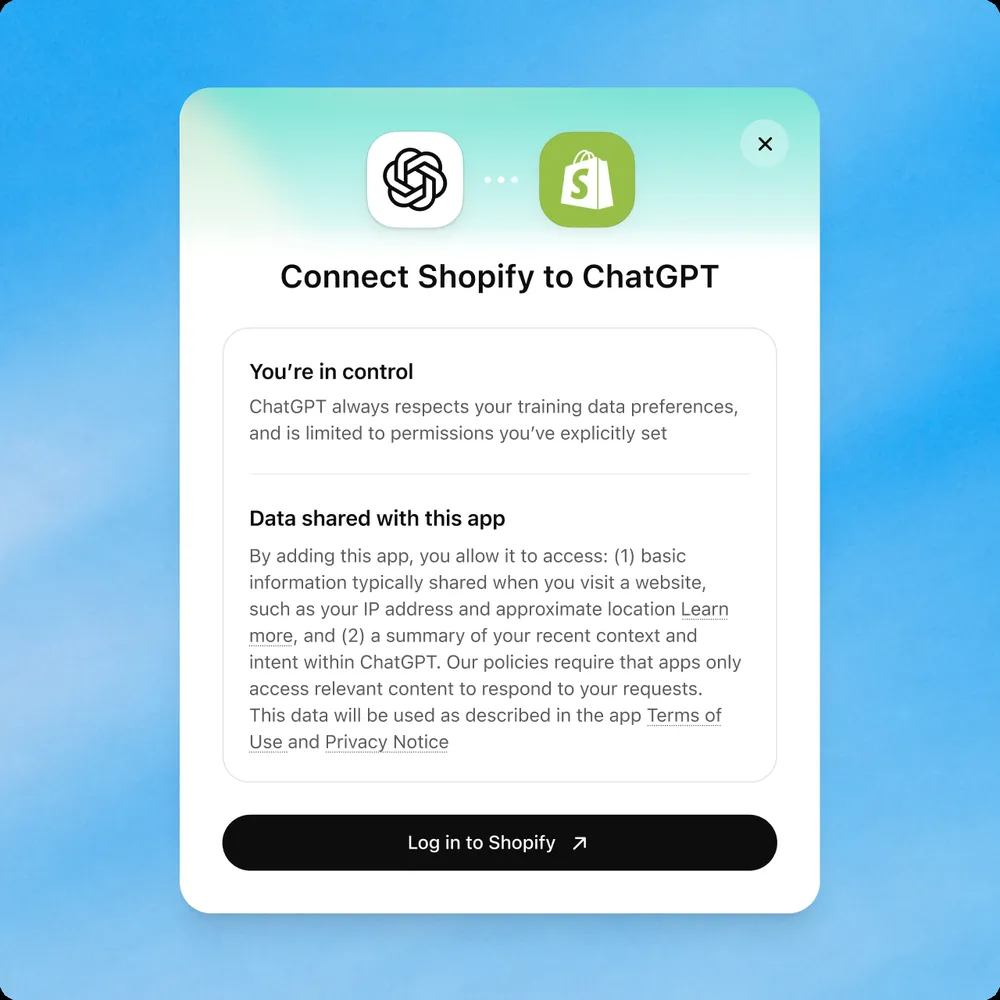
Pass the Persona identity check. This is the step people skip — and the one that locks everything. Persona, the third-party service OpenAI uses, checks your government-issued ID and possibly your business registration and proof that you can act for the company. Until Persona approves you, you cannot publish profile changes, view Insights, or create a Business Agent. Your verified badge — the blue check — appears only after Persona approval. Persona deletes uploaded IDs and selfies within 7 days of verification; OpenAI receives only your date of birth or age prediction, not the documents.
Treat this check as non-negotiable — it is the gate that decides whether how to get ChatGPT to recommend your business moves forward at all. For a small business, this is the step that decides whether how to get ChatGPT to recommend your business ever gets past the starting line.
Fill out the profile completely. Website, description, one category from OpenAI’s fixed list, logo, cover photo, delivery and return policies, and a product feed if you sell online. Then check your Insights: mentions, website clicks, and the topics you are cited for, over the past 28 days. That is the loop that shows whether your work on how to get ChatGPT to recommend your business is actually paying off — and it is the part most businesses never reach, because they stop after the first verification and never finish the second.
The two-check rule is the whole game: ownership proves the business is yours; Persona proves you are real. Skip the second check and nothing else in how to get ChatGPT to recommend your business works — no edits, no Insights, no agent.
Let ChatGPT See Your Site: OAI-SearchBot and Bing
Many sites block OpenAI’s crawlers in robots.txt without realizing the cost. ChatGPT’s live answers come from its search crawler, OAI-SearchBot — and OpenAI is blunt: sites that opt out of OAI-SearchBot “will not be shown in ChatGPT search answers.” If you are working out how to get ChatGPT to recommend your business, this is the first gate — before any profile or review can help, ChatGPT has to be able to read your site.
Make sure OAI-SearchBot is allowed: remove any robots.txt rule blocking it, and allow OpenAI’s searchbot IP ranges — published at openai.com/searchbot.json — if your site sits behind a firewall or CDN. Search systems adjust in about 24 hours.
Do not confuse OAI-SearchBot with GPTBot, which collects training data — blocking GPTBot does not remove you from ChatGPT search. You can keep content out of AI training and still appear in ChatGPT answers; we covered the opt-out side in our guide to how to opt out of AI training with robots.txt.
Then check Bing: ChatGPT’s live search leans on Bing’s index, so a business Bing cannot see is one ChatGPT struggles to find. Index your site in Bing Webmaster Tools and list it on Bing Places.
How ChatGPT Learns About Your Business
ChatGPT builds its picture of your business from three channels:
| Source | What ChatGPT learns | How you influence it |
|---|---|---|
| Training data | General knowledge from the web | Publish clear, factual pages |
| Live search (OAI-SearchBot) | Current facts: hours, prices | Allow OAI-SearchBot; keep pages fresh; list on Bing |
| Third-party corroboration | Reviews, mentions, listings elsewhere | Earn honest reviews; keep listings consistent |
No single channel wins a recommendation alone: a claimed profile with no reviews looks thin, and great reviews with a blocked crawler are invisible in live search.
How to Get ChatGPT to Recommend Your Business: Real Examples From Shopping and Skincare
Skeptical that a small business can win a spot in a ChatGPT answer? The evidence says otherwise — and the earliest winners are not all giants. The pattern behind how to get ChatGPT to recommend your business is the same in every case: clear data, honest reviews, and facts that agree everywhere ChatGPT looks. That agreement is the quiet engine of how to get ChatGPT to recommend your business.
Shopping is where it is most visible. OpenAI’s Instant Checkout launched on September 29, 2025, with Etsy as the first marketplace integrated, and Shopify merchants followed — Glossier, SKIMS, Spanx, and Vuori were among the Shopify brands named at launch. Today, Shopify and Etsy catalogs are integrated with ChatGPT shopping with no separate application: when a shopper asks for a product, ChatGPT can show cards with an image, a price, and the merchant.
OpenAI says products are ranked on availability, price, quality, and whether the seller is the maker or primary seller — and that product results are not ads and are not influenced by partnerships. That is the clearest proof that how to get ChatGPT to recommend your business is a data problem, not a budget problem: the merchant whose feed and facts are clearest wins the card.

Brands, not just stores. In a small study published in October 2026, researchers asked ChatGPT three skincare buying questions three times each. La Roche-Posay appeared in all nine answers; Anessa and Beauty of Joseon appeared in all three sunscreen answers; CeraVe and Avène appeared in all three dry-skin answers.
The pattern matches the Ahrefs study of 75,000 brands: branded web mentions correlate 0.66–0.71 with how often a brand shows up in AI answers. Mentions across the web — reviews, roundups, forums — are what ChatGPT leans on when it picks a name, and that is why mentions are the second half of how to get ChatGPT to recommend your business. A brand with no mentions is a brand ChatGPT cannot verify — and verification is the currency of how to get ChatGPT to recommend your business.
The traffic is real, and it is growing fast. Adobe Analytics measured AI-driven traffic to US retail sites up 4,700% year over year in 2026. The absolute numbers are still small for most sites, but the direction is one-way. The businesses that learn how to get ChatGPT to recommend your business now are building the mentions, reviews, and feeds that the next wave of shoppers will see — while most competitors are still invisible.
That is the opportunity in how to get ChatGPT to recommend your business: the work is free, the window is open, and most of your competitors have not started. Start with the claim, then the feed, then the reviews — in that order, how to get ChatGPT to recommend your business becomes a checklist, not a mystery.
Make Your Business Easy to Recommend: One-Sentence Positioning and Consistent Facts
A customer in Austin types: “best bakery near me for a custom birthday cake this weekend.” ChatGPT picks the bakery whose story is easiest to tell in one sentence.
Your job: write the one sentence ChatGPT should use about you. “Maria’s Bakery is a family-run Austin bakery specializing in custom birthday cakes with 48-hour turnaround.” Put it on your homepage, About page, and ChatGPT business profile — same words.
Then make your facts boringly consistent: name, address, phone, hours, services, and prices must match exactly across your website, Business Hub profile, Google Business Profile, Yelp, and every directory. ChatGPT cross-checks sources, and contradictions make it hesitate — or recommend a competitor whose facts agree. Add an Organization or LocalBusiness schema to your site, too: it hands ChatGPT your facts in a format it can read without guessing.
If your site needs help with the technical pieces — schema, crawlability, or a content refresh — take a look at our services or get in touch.
Earn the Reviews That Make ChatGPT Trust You
Reviews are the trust signal ChatGPT leans on hardest: BrightLocal found 97% of consumers read reviews, and 68% will only use a business with four stars or more. An Ahrefs study of 75,000 brands found branded web mentions correlate 0.66–0.71 with how often a brand shows up in AI answers.
Ask happy customers right after a good experience and respond to every review. Twenty recent, detailed reviews beat two hundred stale ones. That steady stream of fresh reviews is one of the strongest signals behind how to get ChatGPT to recommend your business. Never fake it: the FTC’s Consumer Review Rule bans fake reviews, bought reviews, and undisclosed insider reviews, and Google Maps policy bans incentivized or selective review requests. A fake-review shortcut can cost you your listings, your credibility, and real money in fines.
Write Pages ChatGPT Can Quote
ChatGPT recommends businesses it can explain in a sentence or two — so your site needs pages written to be quoted, not just read.
Take a real example: a Dallas plumber writes a page titled “Emergency Plumber in Dallas: What to Do When a Pipe Bursts at 2 AM” — cost range, response time, and the exact steps a homeowner should take. That gives ChatGPT a ready-made answer. A plumber whose site just says “we do plumbing” gives it nothing.
Build answer-first pages for what customers actually ask: prices, turnaround, what’s included, what to expect. Lead with the direct answer, then the detail. This is the same approach that wins featured snippets on Google — and it matters more now that AI search reads your pages the same way, as we covered in our Google AI Mode update for October 2026.
How to Get ChatGPT to Recommend Your Business More Often: Test, Measure, Repeat
Once a month, run a prompt test: open a fresh ChatGPT session and ask the exact questions your customers would ask — “best bakery in Austin for a birthday cake,” “affordable plumber in Dallas,” “where can I buy handmade candles online.” Note whether your business appears and whether any fact is wrong — then fix it and test again next month.
Pair that with Business Hub Insights and Search Console’s generative AI performance report. Movement is slow — crawling takes days to weeks, mentions and reviews build over months — but the trend line is what matters. The businesses that get recommended by ChatGPT showed up first, claimed their profile, kept their facts straight, and kept testing.
How to Measure Whether ChatGPT Is Recommending Your Business
A recommendation you cannot see is a guess. Measurement has three layers — and you need all three, because each one catches something the others miss. Together they answer the only question that matters for how to get ChatGPT to recommend your business: is it working, and where is it stuck? Most businesses measure nothing, which is why most businesses stay invisible — and why measuring is the cheapest edge in how to get ChatGPT to recommend your business.
Layer 1: Business Hub Insights. The simplest check, and the one only claimed businesses get. Once your Persona check is approved, Business Hub shows how often ChatGPT mentions your business, how many website clicks those mentions generate, and the topics you are cited for — aggregated over the past 28 days, the clearest scoreboard for how to get ChatGPT to recommend your business.
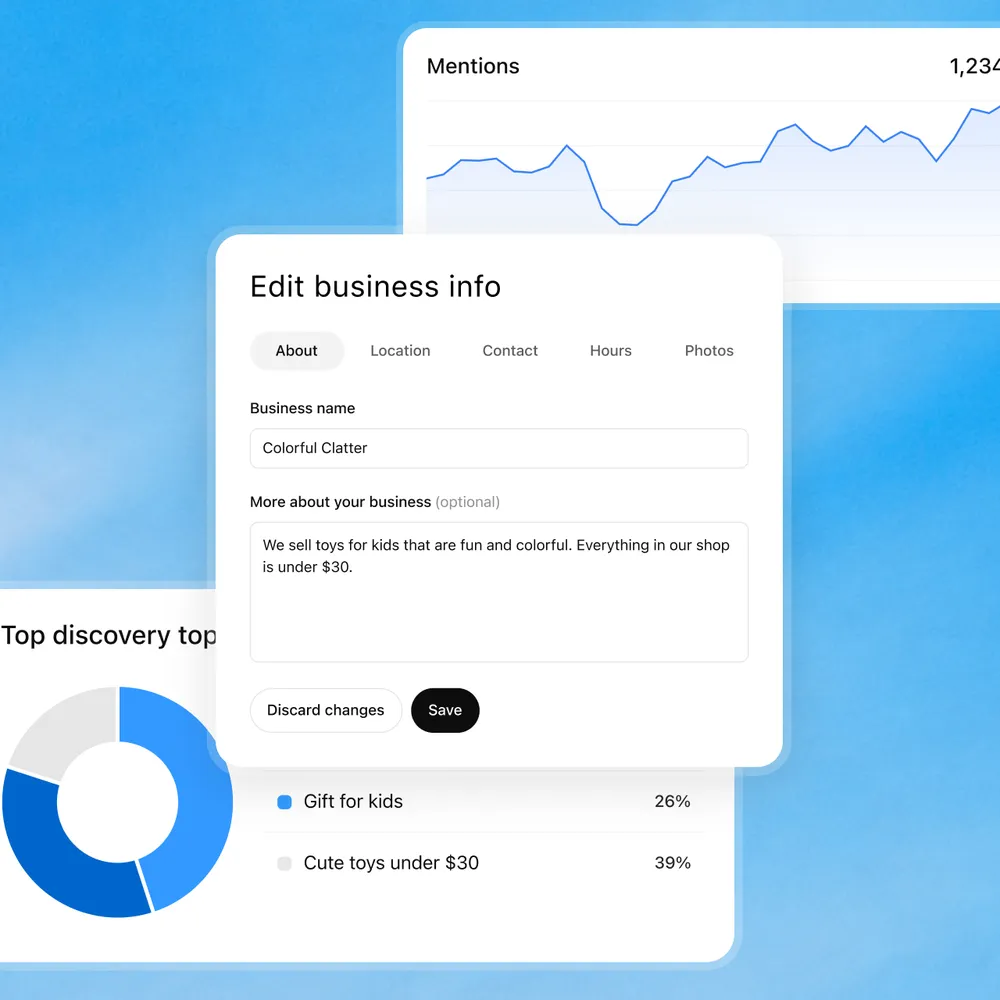
OpenAI’s own example dashboard shows a toy shop, Colorful Clatter, with 1,234 mentions and top discovery topics like “Cute toys under $30” (39%) and “Gift for kids” (26%). If mentions are rising but clicks are flat, your facts are appearing but not compelling a visit: tighten the description and the offer on your landing page. Watch the trend weekly; a flat line is the first sign that how to get ChatGPT to recommend your business has stalled.
Layer 2: your analytics. ChatGPT adds a utm_source=chatgpt.com tag to referral links from its search results, so in Google Analytics 4 look for source chatgpt.com. GA4 also added a native AI Assistant channel on May 13, 2026, which groups sessions from recognized assistants — ChatGPT, Gemini, DeepSeek, Copilot, and Grok — under the medium ai-assistant, with no setup.
Two warnings: ChatGPT often sends no referrer at all, so many visits land in Direct; and the tag itself can break — when GPT-6 rolled out in October 2026, the utm tag vanished for a week (October 8–15), and Adobe data showed about 31,000 fewer ChatGPT visits a day counted across 500 pages while Direct rose by 26,000 a day.
OpenAI fixed it on October 15, but the lesson stands: build a custom GA4 channel group for AI assistants (matching chatgpt, perplexity, copilot, gemini, claude) and place it above Referral, so a broken tag does not erase the traffic from your reports. That safety net is part of how to get ChatGPT to recommend your business — because a win you cannot see is a win you cannot repeat. Without that safety net, you are flying blind on how to get ChatGPT to recommend your business.
Layer 3: prompt tests and server logs. Once a month, run the prompt test from the section above in a fresh ChatGPT session and log whether your business appears and whether any fact is wrong. For harder evidence, check your server logs: OAI-SearchBot hits show which pages the search index holds, and ChatGPT-User fetches fire when the assistant pulls your page live during a conversation — each hit is a moment your page was pulled into an answer, whether or not anyone clicked.
If the logs show fetches but your prompt tests show no mention, the problem is not visibility — it is relevance or trust, and the fix is reviews and clearer pages, not more claiming. That diagnosis is the real payoff of measuring how to get ChatGPT to recommend your business instead of guessing.
Put the three layers together and how to get ChatGPT to recommend your business becomes a number you can track — mentions up, clicks up, facts correct — instead of a hope.
Frequently Asked Questions
Can you pay ChatGPT to recommend your business?
No — OpenAI says placement is not guaranteed, and recommendations are independent of payment. ChatGPT does show ads to some Free and Go users, labeled as sponsored — but those are ads, not recommendations.
How do I get my business to show up in ChatGPT?
Allow OAI-SearchBot in robots.txt, claim and complete your Business Hub profile, keep your facts identical everywhere, earn honest reviews, and publish answer-first pages. There is no single switch for how to get ChatGPT to recommend your business — the combination makes you visible.
Does claiming a Business Hub profile guarantee more recommendations?
No — anyone who tells you otherwise is selling something. Claiming buys accuracy, not rank: ChatGPT describes your business using your own facts, but the recommendation is still earned through reviews, mentions, and relevance.
How long does it take to show up in ChatGPT recommendations?
Crawl changes take days to weeks after you fix robots.txt or claim your profile. Mentions and reviews build over months; expect accurate facts within weeks and real movement in two to three months.
How do I know if ChatGPT is recommending my business?
The short answer: watch mentions, clicks, and prompt results — the three signals that show how to get ChatGPT to recommend your business is working. Check three places: Business Hub Insights (mentions and clicks over the past 28 days, once your Persona check is approved); Google Analytics 4, where ChatGPT visits arrive with the source chatgpt.com or in the native AI Assistant channel; and a monthly prompt test in a fresh ChatGPT session, asking the exact questions your customers ask.
If Hub Insights shows mentions but GA4 shows no clicks, your facts are appearing but not winning the visit — and that is the fastest way to confirm whether how to get ChatGPT to recommend your business is working for you.
Why doesn’t ChatGPT recommend my business even after I claimed my profile?
Claiming buys accuracy, not rank — OpenAI says so directly. The usual culprits: you skipped the Persona identity check, so your profile edits never published; your site blocks OAI-SearchBot in robots.txt; your facts disagree across your website, Google Business Profile, and directories; or you have almost no reviews or mentions for ChatGPT to corroborate. Fix those first, then give crawling days to weeks and mentions months to build. That checklist is the unglamorous core of how to get ChatGPT to recommend your business: the profile makes your facts right, but the recommendation is earned.
Can a small business get recommended, or only big brands?
Small businesses can — the earliest ChatGPT shopping winners include independent Etsy sellers and Shopify stores, not just the big names. What matters is not size but clarity: a complete product feed or profile, consistent facts, honest reviews, and pages that answer real questions. The top 10 results for how to get ChatGPT to recommend your business are all small sites — proof that this is a winnable race for a small business that moves first. That is the whole playbook for how to get ChatGPT to recommend your business on a small budget: clarity beats size, every time.
The Bottom Line
Learning how to get ChatGPT to recommend your business in 2027 starts with acting in late 2026. Claim your Business Hub profile today, let OAI-SearchBot in, keep facts identical everywhere, earn reviews honestly, and write pages worth quoting. Test monthly and fix what’s wrong — your competitors are still invisible.