Machine Learning, in today’s digital age, is more than just a buzzword. It’s a technology that powers many tools and services. Machine learning works behind the scenes, whether it’s to improve search results, detect fraud in banking applications, or get movie recommendations.
Two important approaches are at the heart of machine learning: supervised and unsupervised learning. These two concepts are a great place to begin if you’re new in AI or want to learn how machines can actually learn by analyzing data. These concepts define how models can be trained, the data that they use and the types of problems they are able to solve.
We’ll explain both approaches in this article. We’ll go beyond just defining them, to understand how they work and where they’re used.
Understanding Machine Learning in Simple Terms
It’s important to know what machine learning is before comparing it with supervised and non-supervised learning. Machine learning is an aspect of Artificial Intelligence which allows computers to learn by analyzing data rather than relying on instructions that are written by humans.
In traditional programming you have to tell the computer what it should do. In machine learning, however, the data is given to the system and it works out patterns by itself. It becomes better at making predictions or decisions as it gains more data.
Machine learning is a powerful tool. It can handle complex tasks, adapt and improve. How a machine learns is dependent on the data it receives. This is where supervised learning and unsupervised training come into play.
What is Supervised Machine Learning?
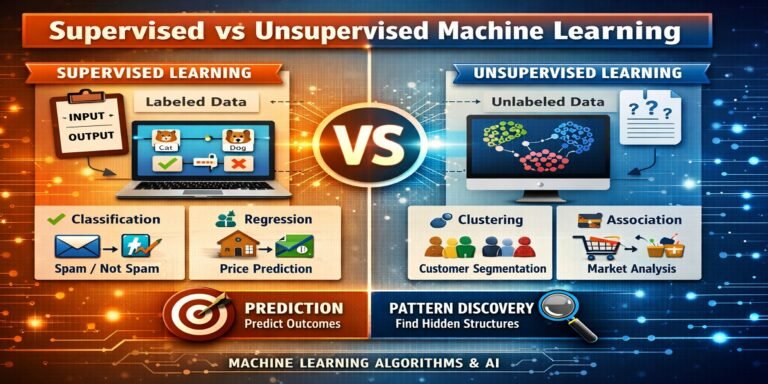
The easiest way to understand supervised learning is that it’s similar to how we learn at school. This method involves labeled data being used to train the model. In this method, every input data item has the right answer.
Imagine that you are a student who is given questions and answers by a teacher. You will eventually understand the pattern, and be able to solve similar questions by yourself. This is exactly how supervised education works.
If you want to build a system that can detect spam, you could train it by using examples of emails already classified as spam or not spam. The model will then learn what makes an email spam. It can then make a forecast based on the information it has learned when it receives a new message.
How Supervised Learning Actually Works
Each step in the process of supervised-learning is crucial. You must first collect a dataset containing both correct inputs and outputs. These outputs are known as labels.
After you collect data, clean it up. Remove errors, handle missing values, make sure that everything is in an usable format. After the data collection phase, you move on to the training stage where you use a machine-learning algorithm.
During training the model compares its predictions with the real answers. The model will adjust itself if the prediction turns out to be incorrect. The model will repeat this process until it becomes accurate.
The model is then tested against new data in order to determine how it performs under real-world conditions. It is because of this structured approach that supervised learning is used widely in applications where accuracy is important.
Types of Supervised Learning
Two main types of supervised learning are classification and regression.
When you want your model to select between different categories, classification is the way to go. You can use classification to decide whether or not an email is spam, or whether or not an image contains either a cat, or a dogs. This is not a numerical output but rather a class or label.
Regression is used instead when the output is just a number. Predicting house prices, temperatures, or sales revenue are examples. The model does not choose a category but instead gives a numerical value.
The two types of solutions are both extremely useful, and can be applied to a wide range of real-world situations depending on the issue.
Common Algorithms in Supervised Learning
Each algorithm has a specific purpose. Some algorithms are simpler, while others can be more complex.
For classification problems, logistic regression is preferred over linear regression. They are popular due to their simplicity and visual appeal. Combining multiple decision trees improves accuracy.
Support vector machines are very powerful, especially for complex data. In advanced applications such as image recognition and voice processing, neural networks are used. They are inspired by the brain.
The algorithm you choose depends on what you are trying to solve, and the data that you have.
Why Supervised Learning is Useful
Accuracy is one of the greatest advantages of supervised-learning. When trained correctly, the model can make accurate predictions because it learns from correct responses.
You can also evaluate it more easily because you know what the output is expected to be. The model’s performance can be directly measured. This makes supervised-learning ideal for tasks that require precision, such as medical diagnosis or fraud detection.
Clarity is another benefit. It’s easier to understand the model because inputs and out-puts are clearly defined.
Challenges in Supervised Learning
Although supervised learning has many benefits, it is not perfect. Labeled data is a major problem. Labeling datasets takes a lot time, money, and effort.
Overfitting is another challenge. Overfitting occurs when a model is too focused on the training data, and does not perform well with new data. It memorizes patterns instead of learning them.
It is possible to avoid this by using techniques such as regularization and proper validity, but still, it requires careful handling.
What is Unsupervised Machine Learning?
Unsupervised learning is a totally different process. The model is presented with data that are not labeled. No correct answers are provided.
The model does not learn from examples but instead tries to discover patterns by itself. It searches for hidden structures, similarities and differences in the data.
Imagine it as if you were exploring something completely new, without any guidance. The system is left to its own devices, as there’s no teacher. Unsupervised learning is more flexible but also more complicated.
How Unsupervised Learning Works
Unsupervised learning begins with raw data without labels. The model analyses this data to try and organize it in an meaningful way.
It could, for example, group data points that are similar together or reduce their complexity to make them easier to understand. These patterns can be used to make decisions.
The results are not always clear because there are no predefined questions. They can reveal valuable insights that are difficult to discover manually.
Types of Unsupervised Learning
Clustering and association are the two most common unsupervised learning methods.
Clustering involves grouping items that are similar together. Businesses use clustering, for example, to separate customers into groups based upon their behavior. This is useful for targeted marketing.
Associating items is all about identifying relationships. One common example would be identifying products which are often purchased together. It is used widely in online shopping platforms.
These two techniques are more useful for understanding data than predicting outcomes.
Algorithms Used in Unsupervised Learning
K-Means Clustering is a popular algorithm in unsupervised learning. It groups data into clusters on the basis of similarity. Hierarchical Clustering uses a tree structure to display relationships.
DBSCAN can be used to detect outliers or patterns that are unusual. Principal Component Analysis reduces the complexity of data, while retaining important information.
Each algorithm is selected based on its strengths.
Benefits of Unsupervised Learning
Unsupervised learning has the advantage of not requiring labeled data. Unsupervised learning is very useful in situations where labeling data may not be possible.
You can also use it to explore data and discover hidden patterns. Businesses use it to better understand their customers’ behavior, make recommendations, and detect abnormal activity.
It can handle big datasets and give insights that are not always obvious.
Limitations of Unsupervised Learning
Unsupervised learning has also its disadvantages. It can be difficult for learners to interpret results when there are no answers.
There is no way to know which algorithm is right. It’s also difficult to evaluate performance because there is no standard against which to compare.
Unsupervised learning is often difficult to use effectively without domain knowledge and experience.
Supervised vs Unsupervised Learning: Key Differences
Data is the main difference. Supervised learning is based on labeled data, and it focuses on making forecasts. Unsupervised learning focuses on patterns and uses unlabeled information.
Supervised learning tends to be more accurate and easier measured, but it relies heavily on labeled information. Unsupervised learning can be more flexible and helpful for exploration but is also harder to understand.
Both methods are used in practice to create better systems.
Real-World Use Cases
In the areas of spam detection, fraud diagnosis, medical diagnosis and voice recognition, supervised learning is employed. These tasks require accurate and clear predictions.
Unsupervised learning can be used for customer segmentation, recommendation system, anomaly detection and data analysis. These tasks are more focused on patterns.
Modern applications often combine both approaches in order to achieve the best results.
The Future of Machine Learning
Machine learning becomes more accessible and advanced as we progress. Self-supervised learning is a new approach that combines the strengths of supervised and unsupervised training.
Machine learning is becoming more popular as businesses adopt big data and cloud computing to gain insight and improve their efficiency.
Smarter systems, which can learn faster and require less manual work, will be the future.
Conclusion
Modern machine learning is built on the basis of supervised and unsupervised learning. Each has its strengths and challenges.
Unsupervised learning is the best way to explore data and find hidden patterns.
Understanding both approaches will help you choose the best method for your particular problem, and use machine learning more effectively in real-world situations.
FREQUENTLY ASKED QUESTIONS
1. Supervised vs Unsupervised Machine Learning Examples
In Machine Learning, supervised learning examples include spam detection and price prediction, while unsupervised learning includes customer segmentation and clustering.
2. Difference Between Supervised, Unsupervised, and Reinforcement Learning
Supervised uses labeled data, unsupervised finds patterns in unlabeled data, and reinforcement learning learns through rewards and penalties.
3. Supervised vs Unsupervised Machine Learning Python
In Python, supervised learning uses labeled datasets (e.g., classification), while unsupervised uses clustering algorithms like K-Means.
4. Supervised vs Unsupervised Machine Learning GeeksforGeeks
According to GeeksforGeeks, supervised learning predicts outputs using labeled data, while unsupervised learning discovers hidden patterns.
5. Supervised vs Unsupervised vs Reinforcement Learning
Supervised predicts outcomes, unsupervised finds patterns, and reinforcement learning improves decisions using feedback.
6. Types of Supervised and Unsupervised Learning
Supervised types include classification and regression, while unsupervised types include clustering and association.
7. Supervised and Unsupervised Data
Supervised data is labeled with correct outputs, while unsupervised data has no labels.
8. Supervised Learning Examples
Examples include spam detection, disease prediction, face recognition, and stock price forecasting.