In the fast-changing world of technology, terms such as Machine Learning or Computer Vision can be used interchangeably. While they are related, they’re not the same. Students, developers and businesses who want to take advantage of modern AI technologies need to understand the differences between these two fields.
Machine Learning and Computer Vision both fall under Artificial intelligence (AI) but serve different purposes and are used to solve different problems. This comprehensive SEO optimized guide will explain what each field is, how it differs, the real-world applications and which might be best for your project or career.
What is Machine Learning?
Machine Learning (ML), a subset in Artificial Intelligence, allows computers to improve their performance by learning from data without having been explicitly programmed.
Rather than writing rules that are fixed, developers can train models by using data to identify patterns and take decisions automatically.
Machine Learning: How it Works
Machine learning works in the following ways:
- Data collection
- Data preprocessing
- Model training
- You can also check out our website for more information.
- Prediction
Machine Learning Types
- Supervised learning – Trained with labeled data
- Unsupervised learning – Finds patterns from unlabeled data
- Reinforcement learning – Learns by rewards and penalties
Machine Learning Example
- Email spam detection
- Product recommendation systems
- Stock market forecasts
- Voice Assistants
What is Computer Vision?
Computer Vision is an AI field that allows machines to understand and interpret visual data, such as images and video.
The focus is on teaching computers to “see” visual content and extract useful information.
Computer Vision: How it Works
Computer vision systems usually follow these steps.
- Image Acquisition
- Image Processing
- Feature extraction
- Pattern Recognition
- Decision Making
Common Computer Vision Tasks
- Image Classification
- Object detection
- Facial Recognition
- Image segmentation
Computer Vision Example
- Face unlocking on smartphones
- Self-driving cars detecting objects
- Medical Image Analysis
- Surveillance systems
Key Difference Between Machine Learning and Computer Vision
Machine Learning and Computer Vision are not the exact same. Let’s explain it clearly:
1. Definition
- Machine learning is a broad field which allows machines to learn by data
- Computer Vision is a subfield that focuses on visual data such as images and videos
2. Scope
- Machine learning covers a wide range of areas, including text, numbers and predictions
- Computer Vision is not limited to visual understanding
3. Data Type
- Machine Learning can be applied to both structured and unstructured data
- Computer Vision is primarily used with images and video
4. Dependency
- Machine Learning is possible without Computer Vision
- Machine Learning is a key component of Computer Vision
5. Complexity
- Image processing is often the cause of more complex computer vision problems
Relationship Between Machine Learning and Computer Vision
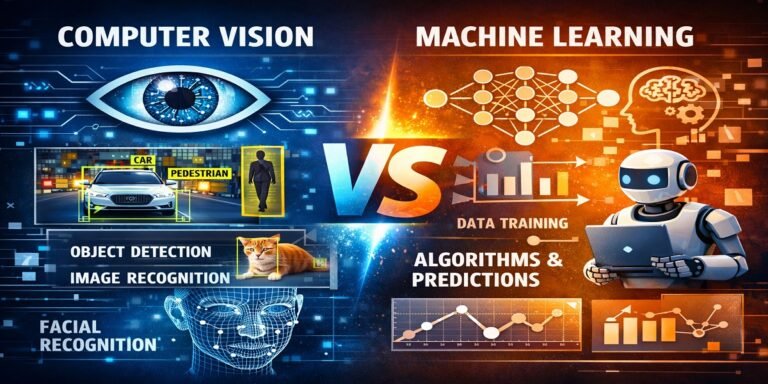
Computer Vision is a subset of Machine Learning and both are under Artificial Intelligence.
To achieve high accuracy, modern Computer Vision systems heavily rely on Machine Learning techniques including Deep Learning.
As an example:
- Face recognition systems use Machine Learning models that are trained on thousands images
- Object detection systems are based on neural networks that identify objects in real time
In simple terms:
Machine Learning = Brain
Computer Vision = the Eyes
Real-World Applications of Machine Learning
Machine learning is used by almost all industries:
1. Healthcare
- Prediction of Disease
- Drug discovery
- Patient data analysis
2. Financial Services
- Fraud detection
- Risk assessment
- Algorithmic Trading
3. E-commerce
- Product Recommendations
- Customer behaviour analysis
4. Cybersecurity
- Threat detection
- Anomaly detection
Real-World Applications of Computer Vision
Computer Vision transforms industries that rely upon visual data.
1. Autonomous vehicles
Computer Vision is used to detect road, pedestrians and obstacles.
2. Healthcare Imaging
Computer Vision is used by doctors to analyze X rays, MRIs and CT scans.
3. Buy it Now
- Automated Checkout Systems
- Customer tracking
4. Security and Surveillance
- Facial Recognition
- Motion detection
Advantages and Disadvantages
Machine Learning
Advantages:
- Work with different types data
- Highly Scalable
- Over time, the quality of your life will improve.
Disadvantages:
- Requires large datasets
- Implementation can be complicated
Computer Vision
Advantages:
- Automates visual tasks
- Deep learning for high accuracy
- Real-time applications are useful
Disadvantages:
- High computational power required
- Sensitive to image quality
- Complex model training
Which One Should You Learn?
Your goals will determine whether you choose Computer Vision or Machine Learning.
Choose Machine Learning If:
- You are looking for a career that is more diverse in AI
- You are interested in data analytics and prediction
- You want to be flexible across industries
Select Computer Vision If You:
- Image and video processing is of interest to you
- You are interested in advanced AI projects such as robotics
- Visual data is your favorite!
Future Trends in 2026 and Beyond
There are several future trends in both fields.
Machine Learning Trends
- Automated Machine Learning
- Why AI Explainable
- Cloud computing integration
Computer Vision Trends
- Real-time Video Analysis
- AI-powered surveillance
- Augmented Reality and Virtual Reality
Machine Learning vs Computer Vision: Which is Better?
There is no single answer that fits all.
- Machine learning is more diverse and versatile
- Computer Vision is powerful and specialized in visual tasks
Start with Machine Learning if you’re a beginner
Computer Vision is a great area to focus on if you’re looking for a specialization.
Conclusion
Machine Learning and Computer Vision both form the core of modern Artificial Intelligence. Computer Vision is focused on visual interpretation of information. While Machine Learning is the basis for learning data, Computer Vision provides a foundation to learn from it.
Understanding the differences between these two fields can help you decide which path is best for your project or career. Machine Learning is a broad field with many applications. Computer Vision offers deep expertise in visual intelligence.
Both fields will be crucial in shaping the future automation, innovation and intelligent systems as technology continues to develop.