Businesses, investors and researchers today rely heavily upon textual information, such as financial reports and earnings calls. They also rely on press releases and corporate disclosures. But reading the information isn’t enough. It is important to understand the tone and sentiment that are behind these disclosures. sentiment analyses play a crucial role in this.
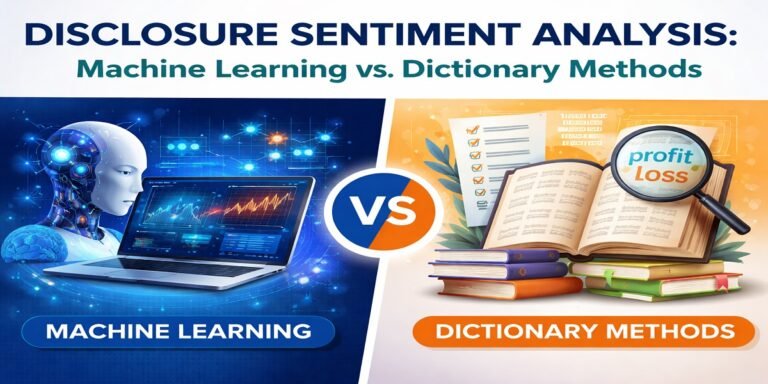
Disclosure sentiment analysis can help determine whether the communication of a company is positive, neutral, or negative. It can provide deeper insight into the financial health of a company, its future outlook and transparency. Machine-Learning methods, and dictionary-based methods are two widely used methods for analyzing the disclosure sentiment.
This article will compare the strengths and weaknesses of both methods, helping you to understand which is most suitable for specific use cases.
What is Disclosure Sentiment analysis?
Disclosure sentiment analysis is the process of evaluating emotional tone and attitude expressed by corporate disclosures. These disclosures can include:
- Annual Reports
- Financial statements
- Transcripts of earnings calls
- Investor Presentations
- Press Releases
It is important to classify text data into categories, such as positive or negative.
As an example:
- “The company achieved record profits this year” (positive)
- “The company suffered significant losses due market instability” (Negative)
Stakeholders can take better strategic and financial decisions by analyzing these sentiments.
Understanding Dictionary-Based Sentiment Analysis
What is the Dictionary Method of Learning?
The dictionary-based approach to sentiment analysis is the oldest and most simple. It uses a list of predefined words that is often referred to as a sentiment dictionary, where each word has been labeled positive, neutral, or negative.
What Does It Do?
The following steps are usually involved:
- Tokenization is the process of breaking down a text into its individual words.
- Matching words to a dictionary of emotions
- The presence of positive and negative words can be used to assign scores.
- Calculating the overall sentiment score
As an example:
- Positive words: “growth,” “profit,” “success”
- Negative words: “loss,” “decline,” “risk”
A disclosure is categorized as positive if it contains more positive words.
Advantages of Dictionary Methods
1. Simple and Easy-to-Use
Dictionary methods don’t require complex algorithms or data for training. These methods are simple and easy to use.
2. Fast Processing
Results can be obtained quickly since there is no need for model training.
3. Transparent Results
Because of the specific words, it is easy to see why a particular sentiment was assigned.
Limitations of Dictionary Methods
1. Lack of context understanding
Dictionary methods do not understand context. Example:
- The word “good” can still make “the results are not good ” positive.
2. Limited Vocabulary
The analysis will not include a word that is not in the dictionary.
3. Poor Performance with Complex Text
Dictionary methods have difficulty interpreting financial disclosures, as they often use complex language.
Understanding Machine Learning-Based Sentiment Analysis
What is Machine Learning Sentiment Analysis (MLSA)?
Machine Learning (ML), sentiment analysis, uses algorithms to learn patterns in data and classify text sentiment. Instead of using fixed word lists to identify sentiment, ML models use large datasets for training.
What Does It Do?
The following steps are involved:
- Collecting data with known sentiment
- Train a machine-learning model
- Text features (such as word frequency or context) can be extracted from the text.
- Predicting the sentiment of new data
Machine learning techniques that are commonly used include:
- Naive Bayes
- Support Vector Machines (SVM)
- Logistic Regression
- Deep Learning Models like LSTM, Transformers and LSTM
Advantages of Machine Learning Methods
1. High Accuracy
Dictionary methods are not as accurate as ML models.
2. Context Awareness
They can understand the context, negation and sentence structure.
3. Adaptability
With new data, models can be re-trained and enhanced over time.
4. Better for Complex Text
ML models are able to handle nuanced words in financial and corporate disclosures.
Limitations of Machine Learning Methods
1. Needs Training Data
To train accurate models, you need a large dataset.
2. Computationally intensive
Computer resources can be required to run some training models.
3. Less Transparent
It can be hard to understand the reasoning behind a particular decision made by a model.
Machine Learning vs. Dictionary Methods: Key Differences
1. Accuracy
Machine learning methods are generally more accurate because they use real data. Dictionary methods are more likely to make errors.
2. Complexity
The dictionary method is simple to use and requires no special training, whereas the ML method requires technical expertise.
3. Context Understanding
Machine Learning models can understand tone, context and sentence structure. Dictionary methods only use individual words.
4. Scalability
Machine learning models scale better when dealing with large datasets. Dictionary methods, on the other hand, may have difficulty with complex and large text.
5. Customization
Models can be customized for specific industries, such as finance. Dictionary methods need manual updates.
Real-World Applications of Disclosure Sentiment Analysis
Both methods are used widely across industries, particularly in finance and business Intelligence.
1. Financial Market Analysis
Investors use sentiment analyses to predict stock trends and evaluate the performance of companies.
2. Risk Assessment
A negative sentiment expressed in a disclosure can be a sign of financial instability or potential risk.
3. Transparency in the Corporate Sector
Companies can improve their communication with stakeholders by analyzing their own disclosures.
4. Monitoring Regulatory Compliance
Financial reports can be scrutinized by regulators to detect statements that are misleading or too optimistic.
Which Method Should You Choose?
Your needs will determine whether you choose Machine Learning or Dictionary Methods.
Select the Dictionary Method if:
- You want a simple and quick solution
- Your technical resources are limited
- You work with small datasets
Choose Machine Learning If:
- High accuracy is required
- You’re analyzing financial texts
- You can access training data and computational resources
The Future of Sentiment Analysis in 2026 and Beyond
Machine Learning has become the most popular approach to sentiment analysis as technology advances. Advanced models such as transforms and large-language models make it possible to understand text in a way that is close to human understanding.
We can expect the following in the future:
- Real-time sentiment analyses of financial disclosures
- Integrating AI with decision-making systems
- Models that are more accurate and contextually aware
- Hybrid approaches that combine both methods are becoming more popular
Conclusion
Disclosure sentiment analysis can be a useful tool to understand the tone and intention behind corporate communications. Both Machine Learning as well as Dictionary based methods have unique advantages and limits.
Dictionary methods may be simple, quick, and easy, but they lack context awareness and accuracy. Machine Learning provides higher accuracy, context understanding and scalability. This makes them perfect for modern applications.
Dictionary methods are a good place to start for beginners or smaller projects. Machine Learning is a better option for large-scale and accurate requirements.
Machine Learning is set to continue playing a major role as we move towards a future driven by AI. It will transform how we interpret and analyze textual data.