
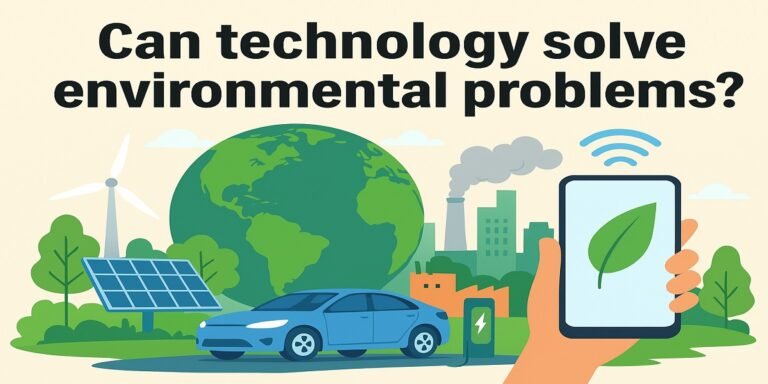
Environmental problems such as pollution, climate change and deforestation are the biggest threats to life on Earth. As these challenges become more intense, one question becomes more important: Can technology solve environmental issues?
The answer to this question in short is is a good tool, but will not solve every problem. To answer the long answer, we need to look at how innovations in energy, transportation and agriculture, as well data science are changing environmental protection.
This article explains in detail, with SEO-friendly content, how technology can be used to solve environmental problems. The article also covers the limitations of technology solutions as well as examples from real life and the future.
What are today’s biggest environmental issues?
Before we can truly appreciate the role of technology, we must first understand what problem it is trying to solve.
1. Climate Change
The increasing greenhouse gas emissions are responsible for global warming, extreme weather conditions and melting glaciers.
2. Air Pollution
The poor air quality in cities is caused by industries, vehicles and the combustion of fossil fuels.
3. Water Pollution
Plastics, chemicals, and wastewater contaminate rivers, oceans, and groundwater.
4. Deforestation
Deforestation leads to soil degradation and reduced carbon absorption.
5. Waste and Plastic Pollution
Cities generate millions of tons of garbage, much of which ends up in landfills or the ocean.
6. Loss of Biodiversity
Climate change, pollution and habitat destruction are all contributing to the extinction of many species.
7. Energy Crisis & Resource Depletion
An over-reliance on fossil energy sources has negative effects on ecosystems and carbon emissions.
Technology is a solution that is possible, but is it effective?
Can the technology solve environmental problems?
The technology is crucial in reducing CO2 emissions. it protects ecosystems. It creates a sustainable environment. However, technology is not sufficient to resolve environmental problems without global cooperation and awareness.
Let’s see how different technologies could help us solve environmental problems.
1. Renewable Energy Technologies: Reduce Carbon Emissions
The use of renewable energy is a key component in environmental solutions.
Solar Power
Solar panels are a direct conversion of sunlight into electricity with no emissions. Rooftop installations and solar farms reduce the dependence on fossil fuels.
Wind Energy
Windmills are a source of clean energy that has become more efficient over time.
Hydropower
Hydroelectric dams, water flow and tidal energy produce clean electricity.
Thermal energy
Heat from the Earth is used to produce electricity and heat.
Benefits from Renewable Energy
- Carbon emission reduction
- Clean energy
- Reduced operating costs
- Creates green jobs
- Reduces dependence on non-renewable resources
Environmental Impact
Renewable energy has a lower overall impact than fossil fuels even though some systems require more land and material.
2. Green Transportation Technologies for Cleaner Mobility
Transportation is responsible for nearly 25% of global emissions. This sector has been revolutionized by:
Electric Vehicles
Electric cars emit zero emissions from the tailpipe, and they can be powered using renewable energy.
Hydrogen-Fuel Cell Vehicles
Only water is produced as a waste product when hydrogen is used to produce electricity.
Public Transport Innovations
- Electric Buses
- High-speed rails
- Automated metro systems
Smart Traffic Management Systems
AI-driven signals for traffic reduce pollution and congestion.
Shared mobility apps
Ride sharing reduces the number cars on the roads.
3. Monitoring the environment through IoT and sensors
Internet of Things provides real-time environmental monitoring.
Air Quality Sensors
Find pollutants like CO2, nitrogen dioxide and PM2.5.
Water Quality Sensors
Monitoring the levels of contamination can help prevent waterborne diseases.
Forest Monitoring Systems
Cameras, sensors and other devices can detect crimes such as illegal logging and forest fires.
Tracking Devices for Wildlife
Help protect endangered species
Smart Cities
The Internet of Things allows for efficient water distribution, smart waste collection and reduced energy consumption.
4. Artificial Intelligence for Environmental Protection
AI can be used for environmental data analysis and risk prediction. It automates sustainability practices.
Use of AI to conserve the environment:
- Climate patterns: Prediction
- Satellite imagery can be used to detect forest deforestation
- Computer vision is used to identify endangered species
- Buildings that are optimized for energy efficiency
- Predicting pollution levels
- Supply chain sustainability: a sustainable approach
AI in Disaster Management
AI systems can predict hurricanes and other weather events, such as flooding or drought. This can protect ecosystems and save lives.
5. Green Building Technologies
Buildings consume nearly 40% of global energy. Sustainability technologies include
Energy-efficient architecture
- Smart Glass
- Solar roofs
- LED lighting
- Natural ventilation
Smart Home Systems
AI-powered sensors and thermostats reduce energy waste.
Green Materials
- Bamboo
- Plastics which can be recycled
- Low-carbon concrete
These technologies enhance quality of life and reduce carbon footprint.
6. Waste Management and Recycling Innovations
Plastic is one of the most dangerous wastes for the environment.
Technology-Based Waste Solutions
- Smart bins that can detect when they are full
- AI-powered Recycling Plant
- Turning plastic waste into fuel
- Biodegradable plastics
- Waste to energy technologies
Circular Economic Technologies
The key characteristics of a product are their reusability, repairability, and recycling.
7. Agricultural Technologies for Sustainable Farming
Agriculture is responsible for soil degradation and deforestation. New technologies offer sustainable alternatives.
Precision Farming
Drones equipped with GPS and sensors are able to optimize water, pesticides, and fertilizers.
Vertical Farming & Hydroponics
Plants are able to be grown in soil-free environments.
Smart Irrigation Systems
Sensors can help you conserve water.
Biotechnology (GM Crops)
Increase yields by reducing pesticides.
Robotics in Agriculture
Automated machinery increases productivity and reduces labor.
8. Carbon Capture & Storage
CCS is a technology that captures and stores CO2 produced by power plants and industries.
Benefits:
- Reduces greenhouse gas emissions
- Supports industries in their transition to net-zero
Limitations:
- High Cost
- Requires stable geological sites
CCS is a crucial part of the climate strategy.
9. Biotechnology for Pollution Cleanup
Biotechnology is a way to remove pollutants by using microorganisms or plants.
Types of bioremediation and their applications
- Bacteria can clean up oil spills
- Plants absorb toxic metals
- Microbes convert waste into energy
It’s also environmentally friendly.
10. Water Purification Technologies
You can solve this problem by:
Reverse Osmosis
Membranes can be used to filter out impurities.
UV Water Purification
It is a powerful antibacterial and virus.
Desalination Plants
Advanced filtering can convert seawater into drinkable water.
Nanotechnology Filters
High-performance filters to clean polluted water sources.
11. Satellite & Drone Technology for Environmental Protection
Satellites gather global data about the environment while drones collect local data.
Applications:
- Climate change tracking
- Monitoring sea-level rise
- Illegal mining detection
- Mapping deforestation
- Hotspots of pollution can be identified
Governments can take quick action with these technologies.
Limitations: Why technology alone will not solve environmental issues
There is a limit to.
High Implementation Costs
EVs, renewable energy plants such as CCS and other advanced technologies can be prohibitively expensive for developing countries.
2. Technological Waste
Tech can produce e-waste, which is a serious problem for the environment if not recycled properly.
3. Technology is driving overconsumption
As technology accelerates production, resource consumption increases.
4. Dependence on Rare Earth Materials
The mining of minerals to make solar panels, batteries, and electronic devices leads to land degradation.
5. Policy Barriers
Adoption of tech is slow in the absence of strong environmental laws
6. Human behavior and lack of awareness
Technology can be useful, but people need to adopt sustainable practices.
Technology plus policy + awareness = Real Environmental Solutions
To solve environmental problems, a combined strategy is needed:
Government policies
Corporate Responsibility
Public Awareness
Technological Inventions
Teamwork is key to realizing the full potential technology has.
Future of Technology in Environmental Protection
The next decade will bring even more progress:
1. Ultra-efficient solar panels
2. Electric Vehicle with Full Autonomy
3. Carbon-neutral cities
4. AI-driven climate forecasting
5. Robots repair ecosystems
6. Smart forests & oceans
7. 100% recyclable products
As technology advances, so does the capability of the planet to repair itself.
Conclusion: Can technology solve environmental issues?
Technology is not enough to solve environmental issues. It can be used to clean water, conserve forests, recycle waste, and monitor changes in the environment. Innovative technology such as biotechnology, smart agriculture, and AI are all helping to combat environmental damage.
is only effective when combined with global cooperation and government policies.